Shoot Seven:
My shoot was a progression of my previous shoot number 3, whereby I photographed images of clouds specifically in the sky, whereas in this shoot I focused on the whole skyline. In this shoot I wanted to capture the beauty of a simple form of nature- the sky. My aim was to capture the beauty of the sky because many people often don't look up, and appreciate it's beauty. By capturing images of the sky, I also feel as though I'd be highlighting the issue of global warming, with the burning of a hole in the Ozone layer. I conducted my shoot outside, and I captured images of the sky in various places, not just one place in order to show how the sky changes constantly, and that no two areas of the sky are the same. I used a tripod in order for there to be no blur in my images, additionally I adapted my camera settings to the dark environment which I photographed my images, this involved me using a low f stop in order to let as much light as possible into my lens. In addition, a low shutter speed also allowed more time for light to get into my camera lens.
For this shoot I was inspired by Stieglitz's images of clouds, likewise to my shoot 3. Stieglitz photographs clouds seizing the movement and pattern of the clouds within the image, giving a closer insight into the actual surface of the cloud, which not many people often pay attention to. Initially I though just focusing on the sky would be boring, however after I saw Steiglitz's photographs I realised that I can create interesting images, using whats above me (the sky.) I chose to develop my shoot 3 by focusing on the whole skyline, not just a few clouds like my shoot 3 did.
I photographed my images both outside my house, and at a local park. I'm happy with the overall outcome of my images, as the bright colours are clearly visible and I believe my aim to highlight the issue of global warming, through the beauty of the sky was achieved. I am especially pleased with the colours in the images, as I believe the colours show the emotions of the sky itself.
In my next shoot (shoot eight) I will be developing my idea of macro photography, which was previously explored in shoot number 4, I will be shooting the objects of peppers again, however this time I will be shooting inside the pepper, not from the outside of this organic object; also, I will be experimenting with low key lighting to see how this affects my images.
Tuesday, 15 November 2016

Monday, 7 November 2016
Shoot Five - Essay Overview
Shoot Five:
In this shoot I wanted to combine images of humans and nature in order to show how we can work well together, I used the technique of multiple exposure to do this, I previously explored multiple exposure before I started this shoot, to ensure I knew how to conduct this shoot correctly. I also wanted to conduct this hoot to suggest that humans are 'made up of nature' as this is what the outcome of the images look like.
In order to create my multiple exposure images I ensured I had 'spot metering' switched on in my camera settings, then I ensured that my images were going to be slightly over exposed by making the F stop higher, to let more light into the camera lens, once I shot both my images of people, and of nature outside the studio I then opened all my images in photoshop. Once the images were opened in photoshop I dragged the image of nature over the top of the individual, whilst changing the photoshop settings on the left side from 'normal' to 'screen'. If after this if I wanted to edit my images further I would select the images specific layer, and change the curves/levels...
I am pleased with the outcome of my overall images, as they are interesting due to the individual appearing as though they are made up of nature, I wasted to do this to demonstrate how us as humans cannot live or survive without nature.
For my next shoot (shoot six) I will be focusing on images of landscapes, and how beautiful they are to encourage our preservation of this. My shoot will be heavily influenced by Ansel Adam's use of black and white, and landscape photography.
In this shoot I wanted to combine images of humans and nature in order to show how we can work well together, I used the technique of multiple exposure to do this, I previously explored multiple exposure before I started this shoot, to ensure I knew how to conduct this shoot correctly. I also wanted to conduct this hoot to suggest that humans are 'made up of nature' as this is what the outcome of the images look like.
In order to create my multiple exposure images I ensured I had 'spot metering' switched on in my camera settings, then I ensured that my images were going to be slightly over exposed by making the F stop higher, to let more light into the camera lens, once I shot both my images of people, and of nature outside the studio I then opened all my images in photoshop. Once the images were opened in photoshop I dragged the image of nature over the top of the individual, whilst changing the photoshop settings on the left side from 'normal' to 'screen'. If after this if I wanted to edit my images further I would select the images specific layer, and change the curves/levels...
I am pleased with the outcome of my overall images, as they are interesting due to the individual appearing as though they are made up of nature, I wasted to do this to demonstrate how us as humans cannot live or survive without nature.
For my next shoot (shoot six) I will be focusing on images of landscapes, and how beautiful they are to encourage our preservation of this. My shoot will be heavily influenced by Ansel Adam's use of black and white, and landscape photography.
Shoot Four - Overview Essay
Shoot Four:
In this shoot I wanted to create abstract images using only a pepper, I wanted the viewer to not be able to guess what the object might be. I chose to conduct my shoot in this manor to show how an everyday fruit (pepper) can be transformed into different things, or be seen entirely differently to what it actually is, likewise to Nadege Meriau. I used the technique of macro photography, using a macro camera in order to get extremely close to the pepper, to make it harder for the viewer to tell what the objet was as a whole. I also used a tripod to control the camera, and reduce and shaking in the frame, as this would have made a vast difference as I was so close to the pepper. I also used a light meter to measure my lighting, and I used studio lights to light up my pepper effectively.
I was inspired by Edward Weston, as he shot his images of various vegetables in a studio, his images are not entirely abstract but they do cause the viewer to look at the object differently to how they would have before. Moreover, I took inspiration from him to convert my images into black and white, in order to highlight the different tones and textures within the image itself.
Nadege Meriau also inspired my heavily as she photographed images of organic objects in the studio, turning them into a new image/environment in themselves. Nadege's images are extremely abstract and don't look like the object they actually are. In my images I used Nadege's technique of being close-up to the object in order to create ambiguity within my own images, I believe this worked within my images as they are extremely abstract.
I photographed the images for this shoot in the college studio, I used a soft box, back lights, a table top, tripod, camera, reflector and a light meter in order to capture my images. I am happy with the overall outcome of this shoot as the pepper doesn't look like a pepper in the photographs, it appears to be something else which was my main aim. I took inspiration from Weston to convert my images into black and white, and inspiration from Nadege in order to get up really close to the object, to create ambiguity in what it was.
In my next shoot (shoot five) I will use the technique of multiple exposure to combine images of nature and people, to create one final image showing how us as humans and nature can work together, also to demonstrate how we are 'made up' of nature, and it helps us to survive.
In this shoot I wanted to create abstract images using only a pepper, I wanted the viewer to not be able to guess what the object might be. I chose to conduct my shoot in this manor to show how an everyday fruit (pepper) can be transformed into different things, or be seen entirely differently to what it actually is, likewise to Nadege Meriau. I used the technique of macro photography, using a macro camera in order to get extremely close to the pepper, to make it harder for the viewer to tell what the objet was as a whole. I also used a tripod to control the camera, and reduce and shaking in the frame, as this would have made a vast difference as I was so close to the pepper. I also used a light meter to measure my lighting, and I used studio lights to light up my pepper effectively.
I was inspired by Edward Weston, as he shot his images of various vegetables in a studio, his images are not entirely abstract but they do cause the viewer to look at the object differently to how they would have before. Moreover, I took inspiration from him to convert my images into black and white, in order to highlight the different tones and textures within the image itself.
Nadege Meriau also inspired my heavily as she photographed images of organic objects in the studio, turning them into a new image/environment in themselves. Nadege's images are extremely abstract and don't look like the object they actually are. In my images I used Nadege's technique of being close-up to the object in order to create ambiguity within my own images, I believe this worked within my images as they are extremely abstract.
I photographed the images for this shoot in the college studio, I used a soft box, back lights, a table top, tripod, camera, reflector and a light meter in order to capture my images. I am happy with the overall outcome of this shoot as the pepper doesn't look like a pepper in the photographs, it appears to be something else which was my main aim. I took inspiration from Weston to convert my images into black and white, and inspiration from Nadege in order to get up really close to the object, to create ambiguity in what it was.
In my next shoot (shoot five) I will use the technique of multiple exposure to combine images of nature and people, to create one final image showing how us as humans and nature can work together, also to demonstrate how we are 'made up' of nature, and it helps us to survive.
Shoot Two - Overview Essay
Shoot Two:
In this shoot I wanted to explore how rain falls differently on both man-made and natural objects. Initially I was going to show the contrast in natural objects in the rain, and then contrast this with humans in the rain; however I felt it was better to explore man-made objects, as these are specifically made to go in the rain, whereas us as humans are not specifically made to withstand rain. I believed that by doing this it would allow me to show how nature needs rain to survive, and how nature is made to enhance rainfall, in comparison to man-made objects which can sometimes be ruined by rain.
inspired by...
I photographed these images in my back garden one rainy afternoon, it was hard to plan when I was going to photograph my shoot as it obviously had to be just after, or during rainfall. I shot my images just after rainfall, as I found during rainfall I would get raindrops on my lens which would ruin the overall image. I found it easy to do this shoot in my garden as I have both plants and man0made objects at easy access, whereas if I went out on location I would not have as much of a choice of the man-made objects. I'm pleased with the overall outcome of the shoot, as my images are aesthetically pleasing and fit my aims of the shoot.
For my next shoot (shoot three) I will be focusing on the simplistic object of a cloud in the sky, I have decided to explore this idea due to inspiration from Stieglitz's images of clouds. I will be exploring how the clouds move, and obtain patterns in this next shoot.
In this shoot I wanted to explore how rain falls differently on both man-made and natural objects. Initially I was going to show the contrast in natural objects in the rain, and then contrast this with humans in the rain; however I felt it was better to explore man-made objects, as these are specifically made to go in the rain, whereas us as humans are not specifically made to withstand rain. I believed that by doing this it would allow me to show how nature needs rain to survive, and how nature is made to enhance rainfall, in comparison to man-made objects which can sometimes be ruined by rain.
inspired by...
I photographed these images in my back garden one rainy afternoon, it was hard to plan when I was going to photograph my shoot as it obviously had to be just after, or during rainfall. I shot my images just after rainfall, as I found during rainfall I would get raindrops on my lens which would ruin the overall image. I found it easy to do this shoot in my garden as I have both plants and man0made objects at easy access, whereas if I went out on location I would not have as much of a choice of the man-made objects. I'm pleased with the overall outcome of the shoot, as my images are aesthetically pleasing and fit my aims of the shoot.
For my next shoot (shoot three) I will be focusing on the simplistic object of a cloud in the sky, I have decided to explore this idea due to inspiration from Stieglitz's images of clouds. I will be exploring how the clouds move, and obtain patterns in this next shoot.
Shoot One - Overview Essay
Shoot One:
My aim for this shoot was to show how peaceful and tranquil nature is when left alone; I wanted to explore this by photographing images of numerous objects, such as flowers, trees... Within this shoot I also wanted to show how different nature is abroad, to what it is here in the UK, this is why all of my images in this shoot I shot whilst on holiday in Gran Canaria.
My inspiration for this soot was National Geographic magazine which I explored, and spoke about in my illustrated project proposal. The magazine has been around for 128 years, it was founded on the 1st of January 1988 by Gardiner Greene Hubbard, and is a non-profit educational and scientific magazine. The National Geographic magazine is not a photographer in itself, however it's a magazine which holds the images of many photographs, all shot in a similar fashion. The National Geographic magazine primarily focuses on images of landscapes, or animals and are big projectors of animal rights and protecting nature, this is shown through their stunning images of landscapes, displaying how we should protect these beautiful landscapes and not ruin them by carelessness (pollution.) The photographs in the national geographic magazine are bright, colourful and eye-cathicng which helps to engage individuals into the image initially, before getting them to think about the issue they may be targeting.
I photographed my images in Gran Canaria, Spain. Nature in Gran Canaria varies vastly from the nature in the UK, as it's more bright, and colourful. I found it extremely interesting to photograph things in which I and never seen before/ wouldn't see in the UK. Additionally, it was extremely bright a lot of the time due to the sunny weather; therefore I had to adjust my camera settings a lot in order to control the lighting that was coming into my lens. I am happy with the outcome of my images, as they are bright, colourful and eye-catching, whilst showing the beauty of nature which was my aim for this shoot.
For my next shoot (shoot two) I will be focusing on how rain appears different on different surfaces including both man-made objects, and natural objects.
My aim for this shoot was to show how peaceful and tranquil nature is when left alone; I wanted to explore this by photographing images of numerous objects, such as flowers, trees... Within this shoot I also wanted to show how different nature is abroad, to what it is here in the UK, this is why all of my images in this shoot I shot whilst on holiday in Gran Canaria.
My inspiration for this soot was National Geographic magazine which I explored, and spoke about in my illustrated project proposal. The magazine has been around for 128 years, it was founded on the 1st of January 1988 by Gardiner Greene Hubbard, and is a non-profit educational and scientific magazine. The National Geographic magazine is not a photographer in itself, however it's a magazine which holds the images of many photographs, all shot in a similar fashion. The National Geographic magazine primarily focuses on images of landscapes, or animals and are big projectors of animal rights and protecting nature, this is shown through their stunning images of landscapes, displaying how we should protect these beautiful landscapes and not ruin them by carelessness (pollution.) The photographs in the national geographic magazine are bright, colourful and eye-cathicng which helps to engage individuals into the image initially, before getting them to think about the issue they may be targeting.
I photographed my images in Gran Canaria, Spain. Nature in Gran Canaria varies vastly from the nature in the UK, as it's more bright, and colourful. I found it extremely interesting to photograph things in which I and never seen before/ wouldn't see in the UK. Additionally, it was extremely bright a lot of the time due to the sunny weather; therefore I had to adjust my camera settings a lot in order to control the lighting that was coming into my lens. I am happy with the outcome of my images, as they are bright, colourful and eye-catching, whilst showing the beauty of nature which was my aim for this shoot.
For my next shoot (shoot two) I will be focusing on how rain appears different on different surfaces including both man-made objects, and natural objects.
Tuesday, 1 November 2016
Glossary
Lenses:
- Zoom lens- a lens whereby the user can change the focal length
- Standard lens- a lens with a focal length of 50mm is deemed 'normal' this type of lens gives a view similar to that of the naked eye, as this lens doesn't magnify or reduce the image.
- Prime lens- this focal length is fixed, therefore the user cannot change this
- Telephoto lens- a narrow field of view occurs, whilst magnifying the image as this lens obtains a larger focal length in comparison to a standard lens.
Technological terms:
- Wide angle- a short focal length creates this angle, giving a wide field of view also.
- Macro- a close up image of an object, which is also of high quality.
- Focal length- the distance between the centre of the lens and the subject/object.
- Field of view- this is what can be seen
Analysis:
- Denotation- the explicit message of the image.
- Connotation- the implied message of the image.
- Stadium- the overall sense of the image, this may include lighting or the overall aesthetic.
- Punctum- this is the one thing in the overall photograph which makes the image different, this could be a portrait with a spider in the centre of the individual's face.
Thursday, 20 October 2016
Detailed Research
Nadege Meriau:
Nadege uses organic matter in the formation of her images, she shoots her organic images using macro photography in a studio, in order to specifically control her lighting. Meriau's use of everyday, recognisable objects to create more abstract images interest me as I would like to recreate this in some of my images also (similar to my shoot number 4.) Nadege creates visual artwork which entices the viewer to question what object it is they're looking at, Nadege feeds off of the world around her. In Nadege's images she allows nature to freely take it corse, whilst manipulating it also to fit her aesthetic aims, she is constantly trying to push boundaries. To Nadege a pumpkin is not just a pumpkin, it's a cave, or a hole in the ground, she uses large/medium format cameras in order to capture her masterpieces;moreover, Nadege prints her images big, in order to allow the viewer to 'travel into' the image itself. Nadege transforms a variety of organic objects like chicken carcasses, snails, honey and melons...


Ansel Adams:
Ansel Adams was born on the 20th of February 1902, and died on the 22nd April 1984, he was born in California and became a strong environmentalist due to the fact he was an only child, consequently he often used to walk in the American countryside whereby he fell in love with the beautiful landscapes. Adam's next love was music, whereby he taught himself to play the piano, however he eventually gave up a musical career for a photographical one. Adam's first started his photography career using a Kodak Box Brownie which his parents had bought for him. The sierra club allowed Adam's his first photographical success- allowing him to publish his first images in 1922. Paul Strand influenced Adam to shoot 'straight photography', not 'pictorial' images, Adam's went on to be the successor of straight photography, whereby Adam's would manipulate the tonal range of his images. Adam's often came into financial issues, which affect his photography greatly as he couldn't always travel to where he wanted to shoot, due to his financial instability.


Nadege uses organic matter in the formation of her images, she shoots her organic images using macro photography in a studio, in order to specifically control her lighting. Meriau's use of everyday, recognisable objects to create more abstract images interest me as I would like to recreate this in some of my images also (similar to my shoot number 4.) Nadege creates visual artwork which entices the viewer to question what object it is they're looking at, Nadege feeds off of the world around her. In Nadege's images she allows nature to freely take it corse, whilst manipulating it also to fit her aesthetic aims, she is constantly trying to push boundaries. To Nadege a pumpkin is not just a pumpkin, it's a cave, or a hole in the ground, she uses large/medium format cameras in order to capture her masterpieces;moreover, Nadege prints her images big, in order to allow the viewer to 'travel into' the image itself. Nadege transforms a variety of organic objects like chicken carcasses, snails, honey and melons...

This photograph is of a dismantled pumpkin, however the image is dark, and dingy appear as though it's a cave, with a star-lit sky being displayed outside. The fibres running down the edge of the pumpkin appear to be hanging tree roots, scraping down the edge of the pumpkin innards. The moistness of the fibres on the floor of the pumpkin, create the image to the viewer that they would be emerged into this, unable to move, almost like quicksand. The fact that Nadege has made the star-lit sky so evident to the viewer demonstrates the direction at which this pumpkin is standing up, therefore showing to the viewer that there is no way out from this pumpkin- you can only look up. In addition, the darker and lighter sides in the pumpkin create a contrast within the pumpkin's structure, making the left hand side of the image appear more mysterious- due to the darkened colouring.

This photograph takes the viewer to an 'underworld', the small beam of light that is projected down onto the weed-looking object in the cave-like space implies that there is a way out to the upper world above the weed, which it is trying to grow towards, as the weed is growing upwards, as it needs nourishment. The surrounding environment around the weed is empty, and hollow implying nothing thrives, or exists here creating a negative perception in the viewers head of this environment; this also creates a question 'why is this weed the only object here' in the viewers head, this causes the viewer to look deeper into the image. The dark brown and greens imply that there's not much light, or water in this environment, as light and water is a life source for plants, helping them to thrive, but, in this image there's no thriving plants. When looking at this image questions also arise of 'what is the environment like in the world above the plant' and 'where is the light coming from', these questions disorientate the viewer.

This photograph is of honeycomb, this is an object we wouldn't usually associate with being photographed, I believe this is why Nadege has photographed this organic object, in order to show that literally anything can be made into art. This photograph is not as abstract, and ambiguous as some of Nadege's other photographs, it's evident that this is a honeycomb; however, the lighting within this image is what really makes this photograph special, the flooring in this photograph is lit up, with some areas darker than others which implies to the viewer that there are some areas thicker of the honeycomb, and others that are thinner, which would let more light through. The peak of honey within the image is framed so it's directly in the middle of the image, drawing the viewers attention straight to this object. Additionally, the dark spots catch the attention of the on-looker as their black colouring sharply contrasts the yellow colouring of the rest of the photograph.
Ansel Adams:
Ansel Adams was born on the 20th of February 1902, and died on the 22nd April 1984, he was born in California and became a strong environmentalist due to the fact he was an only child, consequently he often used to walk in the American countryside whereby he fell in love with the beautiful landscapes. Adam's next love was music, whereby he taught himself to play the piano, however he eventually gave up a musical career for a photographical one. Adam's first started his photography career using a Kodak Box Brownie which his parents had bought for him. The sierra club allowed Adam's his first photographical success- allowing him to publish his first images in 1922. Paul Strand influenced Adam to shoot 'straight photography', not 'pictorial' images, Adam's went on to be the successor of straight photography, whereby Adam's would manipulate the tonal range of his images. Adam's often came into financial issues, which affect his photography greatly as he couldn't always travel to where he wanted to shoot, due to his financial instability.
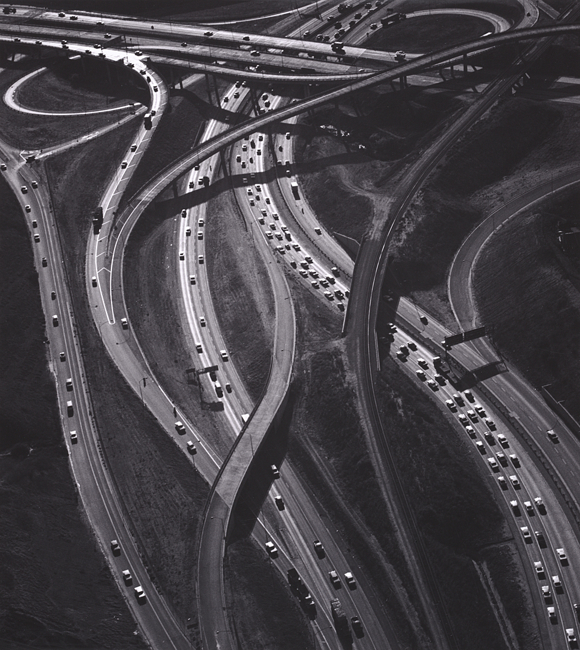
I believe this photograph highlights the issue of pollution, as the image is of roads, with cars on them and cars give of co2 emissions, which contribute to pollution/ the growing hole in the ozone layer. The twist and turns of the roads take the viewers eyes on a journey within the image itself (corresponding with the cars themselves in the image which are all going on a literal journey.) The roads start off reasonably straight, but eventually all end up intertwined with each other. The majority of the roads cluster at the top of the image, the viewer knows that these roads carry on beyond the image, due to their directions and angles which they're positioned, suggesting that these cars will carry on causing pollution, and roads will continue to be constructed. Adam's would have had to photograph this image from a high-up position (e.g. in a helicopter) in order to achieve the angle he has obtained- that similar to a birds-eye view. The birds-eye view of the image suggests that Adam's is a bird looking down on the world below.

The vast contrast of black and white tones really allows the lighter tones to jump out from the image, for example the lake and the mountain are highly visible, compared to the jet black terrain down below in the foreground of the image. The dodge and burn tool would have been used by Adam's in this image to create a vast tonal contrast. This image appears to be God-like as the mountain becomes whiter as it reaches closer to the sky, simulating the idea that it's becoming 'purer' (more white) the closer it becomes to God (the sky.) The lake which is central in the image is almost mirror-like, this may imply that Ansel was asking the viewers of this image to look at themselves in the mirror, and evaluate how their actions effect the environment.

The smoke in the background of the image submerges parts of this photograph, only allowing the viewer too see certain parts of the environment/ image; Adam's may have captured this to symbolise how the media/ Government only wish the public to see certain parts of the environment or have a certain view of it, to shield the troubling effects of pollution. The tree tops in the foreground of this photograph almost appear as though they're spikes, protecting the landscape behind from any harm (pollution), this is symbolic of a mother protecting her child. The harsh contrasts in tones within the image is due to Adam's using the dodge and burn tool to enhance his images, this allows him to control the contrast, and overall have control over the outcome of the whole image.
Stieglitz:
Alfred Stieglitz was born on January 1st 1864 in New Jersey, and died on the 13th July 1946, an American photographer he was instrumental in championing the acceptance of photography as a modern art form, he was also known as a 'perfectionist' in his photographic work. Initially, Stieglitz would not sell any of his images, he kept them all, until his dad set up a photography business for his son to attempt to make some money from his images. In 1892 Alfred bought his first hand-held camera, which was a 4x5 plate film camera, this made it easier for Alfred to carry his camera around as his previous camera always needed a tripod (the 8x10 plate film camera.) Alfred merged the two photographic groups called society of amateur photographers, and the New York camera club in May 1896, he wanted to change their old fashioned ways and develop their photographic skills. Stieglitz's cloud study occurred between 1922-35, he believed he was combining photographic objectivity and personal emotion, it could be suggested Stieglitz was portraying his own emotions/ideas through the clouds and their shape, lines, tones and patterns; therefore you could suggest that the clouds were very much Stieglitz himself.
Alfred Stieglitz was born on January 1st 1864 in New Jersey, and died on the 13th July 1946, an American photographer he was instrumental in championing the acceptance of photography as a modern art form, he was also known as a 'perfectionist' in his photographic work. Initially, Stieglitz would not sell any of his images, he kept them all, until his dad set up a photography business for his son to attempt to make some money from his images. In 1892 Alfred bought his first hand-held camera, which was a 4x5 plate film camera, this made it easier for Alfred to carry his camera around as his previous camera always needed a tripod (the 8x10 plate film camera.) Alfred merged the two photographic groups called society of amateur photographers, and the New York camera club in May 1896, he wanted to change their old fashioned ways and develop their photographic skills. Stieglitz's cloud study occurred between 1922-35, he believed he was combining photographic objectivity and personal emotion, it could be suggested Stieglitz was portraying his own emotions/ideas through the clouds and their shape, lines, tones and patterns; therefore you could suggest that the clouds were very much Stieglitz himself.

This photograph of clouds is textured due to the clouds appearing 'rippled' in the sky, when initially looking at the image it is not clear what this photograph is of, as the whole frame of the image is submerged by clouds making it hard to see any surrounding stimuli (e.g. the sky) which may give away a clue of what this image is of. The various tones within the image are created by the lighting, and shadowing that occurs within the environment of the photograph, the sun would control this in the instance of clouds. The overall colouring of this image is dark, and dreary suggesting that this photography may have been taken on a stormy day, representing Stiegltiz's emotion in that moment of anger, or frustration. The angle which this image is photograph appears to be looking upwards at the sky, this could imply Stieglitz was trying to looking up, and be positive despite his angry and emotional state of mind.
The clouds in this image appear tranquil and calm, which again would have reflected Stieglitz's emotions at the time when photographing this image; the vast contrast of tones within this image could imply that at the back of Stieglitz's mind was slight anger (the small dark patch in the image), however the majority of the image is of lighter tones, implying that he was mostly feeling calm and positive. Moreover the brighter area of the image (top left) may be symbolic of the 'perfect' human as this section is perfectly white- in contrast to the rest of the image which is darker, this may represent the 'real' world, as evidently not every human is perfect. This image appears to be photographed at an ambiguous angle, as you cannot quite see whether this is from underneath or from within the sky itself, this ambiguity allows the viewer to explore the image and question it.

This photograph is extremely interesting as the clouds are shaped in an unusual way, in which we wouldn't usually expect to see them. The linear shaped clouds appear to be gate railings which are spaced roughly evenly apart, blocking vision to the ball of light (the sun) which appears to be behind them- this is symbolic of a gate/railings blocking the way to the 'light at the end of the tunnel.' This symbolic image may imply that the emotions of Stieglitz were negative, as though he feels there's no end, as he cannot reach the 'light at the end of the tunnel.' The fact that you can only slightly see the light is almost teasing the viewer, by allowing them to see this but not quite have it or understand what this light is, or leads to. The ball of light could also be symbolic of heaven, and the idea of trying to lead a good life in order to reach and achieve this goal of getting to heaven; in this context the dark gates (clouds) around the light may symbolise his life and how this can be dark/negative, but his ultimate goal is to reach heaven at the end, and this is his main focus. The angle of this photograph makes the light seem like it's attempting to break through the gates and push forward towards the camera lens.
Edward Burtynsky:


like this- therefore questions are created in the viewers mind. These planes may be army planes as no windows on the planes can be seen, these planes may be being held at a base camp, and will be used to drop bombs on civilians, this creates an uneasy atmosphere as these planes then become 'killing machines' in the viewers mind; contradictory of their perception of planes being positive, as they're used to take individuals on holiday. The angle which Burtynsky has photographed this image is from above, implying he wants to be dominant over this man-made machinery as he believes it could be destructive, and he doesn't want it to dominate or overrule him/his life. Burtynsky has photographed planes as they contribute to the pollution of this planet, the reason that he may have wanted them to be placed so they appeared organised is that possibly this would show how although something can appear quite aesthetically appealing, it can still destroy life, in this case in the form of nature.


“[we] come from nature.…There is an importance to [having] a certain reverence for what nature is because we are connected to it... If we destroy nature, we destroy ourselves" is a direct quote from Burtynsky, this shows in itself why Burtynsky photographs his images the way he does, and the reasoning behind this (preservation of nature) all of his images contemplate the modern issues of life, concerning greed, pollution and destruction of the world. In Burtynsky's images he predominantly focuses on how nature is transformed through industrial means (stone, oil, coal, steel) showing that there's a fine line in the images between attraction and disgust, as the images appear aesthetically pleasing, but not morally appealing/justifiable. Often Burtynsky's images are of rubbish yards, mining areas, quarries... as he states that these are all "places outside of normal experience" yet "we partake in them on a daily basis", essentially the world suffers at our selfish and greedy expense, as we depend on nature so heavily to feed, and fuel us and our machinery which powers our humane world. [http://www.edwardburtynsky.com/site_contents/About/introAbout.html]

This photograph shows roads all intertwined and leading to one route, this could be symbolic of what Burtynsky wants the human race to do; as he wants nature to be preserved, and to do this all humans need to come together with one common aim (to stop pollution) and work on this together, no matter what cultural background. Where the roads meet is in the centre of the image, this may suggest that we will all have to compromise, and 'meet in the middle' if we wish to reach the goal of slowing pollution. This photograph would have been taken up high, in a plane or helicopter, as Burtynsky is extremely high in the air and has a huge wide angled view over this city. The wide angled view of this city could represent the world itself. The horizon in the distance obtains mountains and natural objects, this could imply that if we all follow and co-operate down this road, then we will reach this eventually.

This image emits an uneasy atmosphere as the planes are organised neatly in an empty
field, this pattern is strange as the viewer would not usually see planes placed strategically
like this- therefore questions are created in the viewers mind. These planes may be army planes as no windows on the planes can be seen, these planes may be being held at a base camp, and will be used to drop bombs on civilians, this creates an uneasy atmosphere as these planes then become 'killing machines' in the viewers mind; contradictory of their perception of planes being positive, as they're used to take individuals on holiday. The angle which Burtynsky has photographed this image is from above, implying he wants to be dominant over this man-made machinery as he believes it could be destructive, and he doesn't want it to dominate or overrule him/his life. Burtynsky has photographed planes as they contribute to the pollution of this planet, the reason that he may have wanted them to be placed so they appeared organised is that possibly this would show how although something can appear quite aesthetically appealing, it can still destroy life, in this case in the form of nature.

This photograph is industrial, as cranes are present in this image which implies to the viewer that there may be building work going on, this will show how there's going to be further disruption to wildlife here in this particular area. Burtynsky may have wanted to highlight the area of industrialisation of new builds to show how this can even effect pollution and he lives of wildlife, something which individuals do not think about on a daily basis. The colours in this image are reasonably muted, and are not overly bright or eye catching, this may have been done in order to not take away the attention from the true meaning of this image. This image explores line thoroughly as there's many different types of lines occurring in this photograph, there's straight, curved and diagonal lines within the image which all tell different stories; straight lines imply power, curved lines take your eyes on a journey, and diagonal lines show depth within the image. The two main diagonal lines travel down the centre of this image, they create depth within this photograph as they allow the viewer to see how the background is far away as the lines get smaller the further away they are, in comparison to the foreground, highlighting how big this site actually is.
Edward Weston:
Edward Weston was born in Illinois, and began taking photographs from the age of sixteen when his father bought him his first camera, which was a Bulls Eye 2 camera, before later progressing onto his 8 x 10 view point camera. In 1908 Weston went to college in order to perfect, and train his photographic technique, lighting and positioning were Weston's strongest technical abilities. Weston's images of high key portraits and soft pictorial images gave him a portfolio abroad; however in 1922 Weston turned his focus to a more abstract style of photography, in order to bring out the textures within the organic objects and focus on their structures. The group f/64 was founded by Weston, and contained high-profile photographers including: Ansel Adams, Imogen Cunningham and Willard Van Dyke. Weston's images of organic objects are my main focus for my project, as they tie in with my Nadege Meriau work, Weston's images are extremely abstract, creating new images and environments using just a singular natural object.

This above image is of a carrot/potato, it is hard to work out what the object is which from the off creates confusion in the viewer. The long tenticle-like branches intertwine with each other suggesting unity, as they're all together in one group, this may link to how nature sticks together and stands against any adversity. The viewer would find this image of interest due to them not seeing this type of object in everyday life, therefore due to them attempting to work out what the image is of this would make them more interested and intrigued by this image. The black and white edited colour of this photograph also creates ambiguity as the viewer cannot pull any clues from this image, as to what this subject may based on its colourings.

This photograph is of a cabbage, the vast amount of texture on the top leaf of the cabbage creates a brain-like image within the viewers head, the different lines which sprout off of each other appear similar to the cortex of a human brain, this creates the connotation that nature is the brain of our modern world. The black background allows the cabbage to stand out from the background, as the lighting is just reflected off the object; moreover, the low key lighting creates shadowing on the cabbage, due to the way Weston has placed his lighting, this enhances the texture within the image, and the tonal range- I would like to focus on lighting within my shoots as I believe you can really create the whole image through how you place the lighting this will also help me experiment with tonal range, therefore linking my work to Weston's more effectively.

This image is of a cabbage leaf, although initially I personally believe that it looked like a ladies dress, with all of the pleats flowing down the edges. The texture in this image is highly detailed as the folds in the cabbage leaf overlap and creates shadowing combined with texture. In addition to this, in the bottom left-hand corner of this image it's extremely dark in comparison to the top of the cabbage leaf whereby it's reasonably light, this is exploring the tonal range which creates texture and depth in the overall image.
Subscribe to:
Comments (Atom)